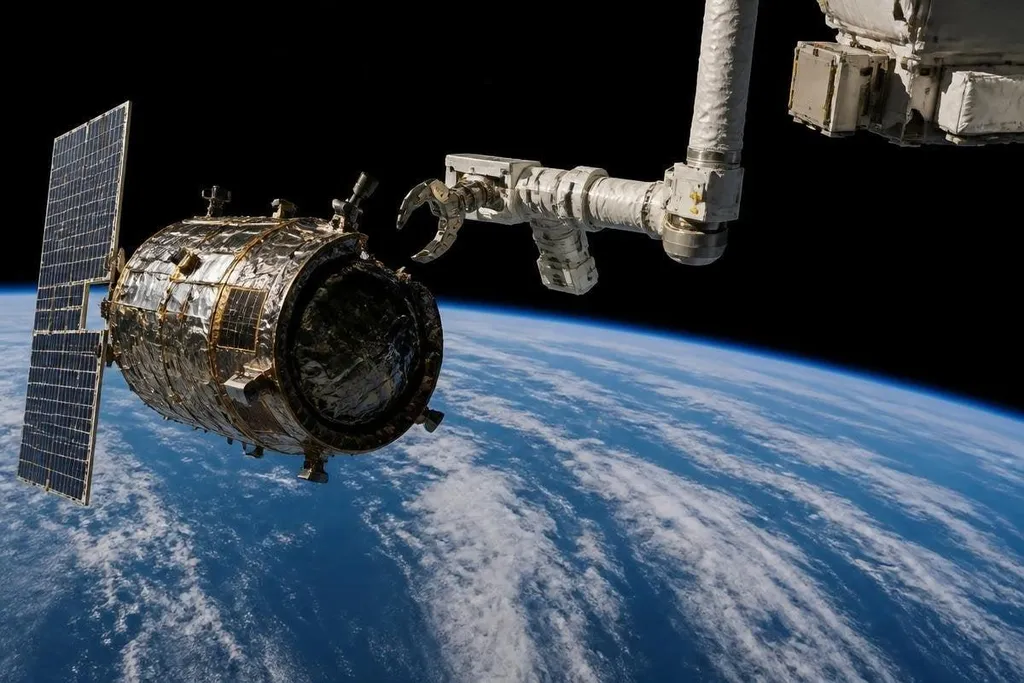
A dead satellite can keep moving around Earth long after its mission ends. A repair robot could reach it, control its motion, and guide it toward a safer orbit or a controlled return.
Quick read
- Robotic spacecraft could inspect, grab, tow, or move dead objects.
- The hardest step is matching the target’s speed and spin without breaking it apart.
- Cleanup needs a clear owner, a safe disposal plan, and a way to pay for the work.
What a cleanup robot would do
Space debris includes dead satellites, spent rocket parts, and fragments from past breakups. A cleanup robot would first find a target, measure its motion, and approach it at nearly the same speed.
That approach matters because objects in orbit move fast. A small error in position or speed can turn a planned capture into a collision, so the robot needs cameras, radar, or other sensors to judge distance and motion.
After the approach, the robot needs a way to hold the target. A robotic arm could attach to a prepared fitting, while a net, clamp, or tether could deal with an object that has no safe gripping point.
Each method fits a different target. A working satellite might accept a docking tool, while a dead rocket body could spin too much for a simple arm to handle safely.
Moving the object is only half the job
Holding a piece of debris doesn't remove the danger by itself. The cleanup spacecraft must then change the target’s orbit, place it in a storage orbit, or guide it toward the atmosphere for disposal.
A controlled return needs care. Large objects may not burn up fully, and an uncontrolled fall could put people or property at risk. A storage orbit also leaves the object in space, so the plan must explain what happens after the robot leaves.
The robot may need to visit more than one target during a mission. That saves fuel and launch mass when the targets sit near compatible orbits, but it also makes the route harder to plan and leaves more time for a fault to develop.
Space-debris plans need the target’s orbit, the robot’s tools, and proof that it can hold a tumbling object. Space-debris robotics reports can put those details beside each mission claim before the next section checks where the plan can fail.
Where the plan can fail
A dead satellite may have damaged panels, leaking fuel, or parts that can break under force. Its maker may also have left no docking point, no service data, and no permission for another operator to touch it.
That legal and commercial gap matters as much as the hardware. Someone must decide who owns the target, who accepts the risk, and who pays if the mission causes new debris.
The robot also has to work without a technician nearby. Operators on Earth can send commands, but signal delays and limited data mean the spacecraft must handle small changes during approach.
A human can stop a task; the robot must first detect that the task is going wrong.
The price question stays open too. A cleanup mission needs a spacecraft, launch, ground control, insurance, and years of planning. If the target has little direct value, public funding or rules that make operators pay for disposal may be needed.
What to check before backing a mission
A serious proposal should answer these points before anyone treats it as a working cleanup plan:
- Target named: Which object will the robot visit, and what condition is it in?
- Capture method chosen: Where will the robot hold the object, and how much force can that point take?
- Orbit plan stated: Will the target move to a disposal path, a storage orbit, or another spacecraft?
- Failure response tested: What happens if the target spins, breaks, or stops answering commands?
- Ownership settled: Who has permission to approach, move, and dispose of the object?
- Cost assigned: Who pays for the mission and for any damage it causes?
I’d back missions that start with one well-understood target and publish the failure plan before launch. A robot that can grab debris is useful; a robot with no safe place to put it has only moved the problem.
The next proof will be a completed mission that approaches, holds, and disposes of a dead object without creating new fragments. Until that happens, space-debris cleanup remains a sound job for robots on paper and an unproven service in orbit.